- Posted on
- No Comments
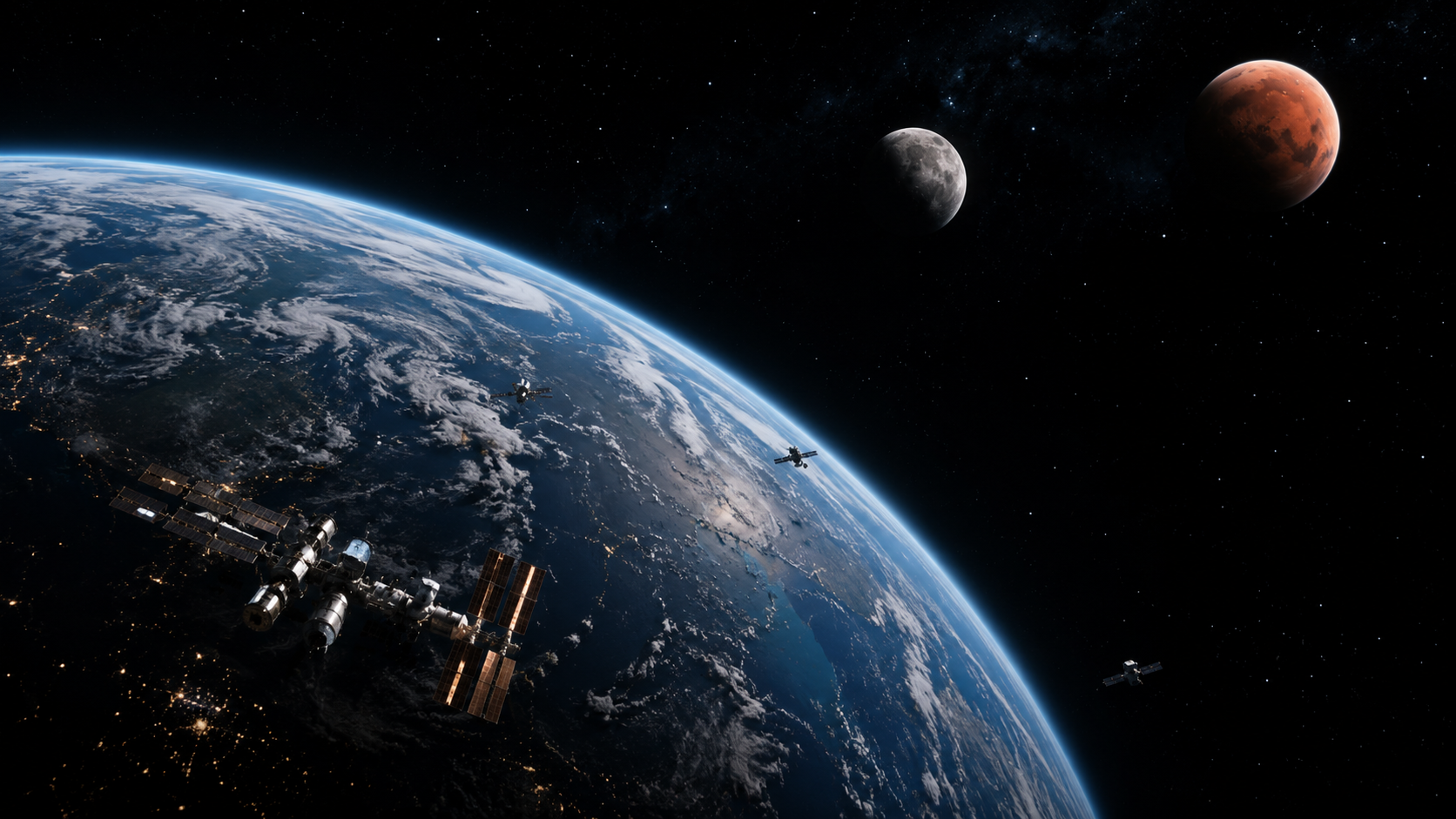
The Off-World Cloud Stack: LEO for Speed, the Moon for Backup, Mars for Civilization Archives
Islomzhon Ibragimov
This article proposes the Off-World Cloud Stack, a location-based framework for organizing future space computing and storage using a single engineering rule: latency chooses the planet. The framework assigns three distinct roles: low Earth orbit (LEO) as a near-Earth speed layer for compute and caching close to space assets; the Moon as a premium disaster-recovery data vault with seconds-level communication delay; and Mars as a long-horizon civilization archive and delay-tolerant batch-compute site where minutes-long one-way delay makes interactive services impractical for Earth users. The analysis evaluates the strengths, limits, and adoption roadmap of each layer and addresses common objections related to cost, maintenance, debris and radiation, power and thermal control, and governance. The central claim is that off-world infrastructure becomes realistic only when each location is matched to workloads that can tolerate its fundamental delay and operational constraints.
Keywords: off-world cloud; low Earth orbit; lunar data vault; Mars archive; edge computing; disaster recovery
1. Introduction
The “cloud” is typically imagined as Earth-based data centers: servers, cooling systems, fiber networks, backup generators, and physical security. That description is accurate today, but it may be incomplete for the next stage of digital infrastructure. Space systems already generate large volumes of data, lunar missions are increasing, and societies are becoming more dependent on digital records. As dependence grows, so does an uncomfortable architectural reality: storing critical digital memory on one planet creates a single-planet failure model.
The question is therefore not whether computers can operate beyond Earth—they already do—but how off-world computing should be organized. A server in low Earth orbit, a data vault on the Moon, and an archive on Mars do not solve the same problem. They differ in distance, one-way delay, energy constraints, maintenance difficulty, and commercial readiness. Treating space as one vague place encourages incorrect assumptions.
This article proposes the Off-World Cloud Stack as a simple division of labor across three locations and one guiding rule: latency chooses the planet. The rule is not a slogan for speed alone; it is a design filter. If a workload requires low delay and frequent iteration, it must remain near Earth. If a workload can tolerate seconds and prioritizes resilience through physical separation, the Moon becomes plausible. If a workload can tolerate minutes and is meant for long-horizon preservation or delay-tolerant processing, Mars becomes relevant. The sections below define the framework, compare the layers, and evaluate objections in a more technical and policy-aware manner.
2. Conceptual Background: What the Stack Means
A cloud stack in software divides responsibilities into layers. The Off-World Cloud Stack applies this logic to physical locations beyond Earth and asks a practical question: if a workload must leave Earth, should it run near Earth, on the Moon, or on Mars?
The answer begins with latency: the unavoidable signal-travel delay caused by distance and limited by the speed of light. NASA describes LEO as approximately 160 to 2,000 kilometers above Earth (NASA, 2026c). NASA also provides Moon distance information suitable for basic delay intuition (NASA, 2026a). Mars is fundamentally different; depending on orbital geometry, one-way communication delays can reach roughly 20 minutes (NASA, 2024). While improvements in relay networks and protocols can reduce overhead, the dominant component is light-travel time, which cannot be engineered away.
2.1 Definitions and abbreviations
Throughout the article, the following abbreviations are used: LEO (Low Earth Orbit), MEO (Medium Earth Orbit), and GEO (Geostationary Earth Orbit). Only LEO is used as a stack layer in this framework; MEO and GEO are referenced to clarify that “near-Earth space” includes multiple orbital regimes with different delays and operational trade-offs (NASA, 2026c).
Figure 1. The Off-World Cloud Stack
Source: Author-created diagram.
Table 1. Functional comparison of the three layers
| Layer | Best role | Why it fits | What it should not do |
|---|---|---|---|
| LEO | Fast compute and caching | Closest off-world layer; practical for processing satellite data near the source, local routing, and near-Earth services. | Century-scale vaulting that requires long isolation and minimal maintenance. |
| Moon | Premium disaster-recovery data vault | Seconds-level delay is tolerable for backup; physical separation adds resilience against Earth-only disasters and large-scale outages. | Mass-market interactive hosting at normal cloud prices; low-cost general-purpose storage. |
| Mars | Civilization archive and batch compute | Extreme separation is valuable for long-horizon preservation and delay-tolerant processing once local infrastructure matures. | Ordinary interactive web services for Earth users (video calls, gaming, real-time enterprise apps). |
Source: Author-created table synthesizing NASA distance/delay information with the framework proposed in this article.
3. Main Analysis
3.1 Layer 1: LEO as the Speed Layer
Low Earth orbit is the practical starting point because it is closest to the existing space economy and has the shortest repair and replacement cycle. It already contains Earth-observation satellites, communication constellations, crewed platforms, and frequent launch activity. In this framework, LEO is not a replacement for terrestrial hyperscale clouds. Its value is narrower: process and cache data close to where space assets generate it.
A concrete scenario is satellite imaging. Today, a satellite may capture raw observation data, downlink it to a ground station, route it to a terrestrial data center, process it, and then deliver results. In an orbital edge-computing model, part of the pipeline can occur in orbit: filtering clouds, compressing frames, identifying fires or floods, and prioritizing emergency imagery before downlinking. The benefit is not “magic” but reduced unnecessary data movement and faster time-to-decision for selected workloads.
LEO also supports experimentation because maintenance and iteration are more realistic there than on the Moon or Mars. NASA highlights LEO’s proximity advantages for transportation, communication, observation, and resupply (NASA, 2025b). Early off-world computing will likely be fragile and expensive, so prototypes should begin in the environment where learning cycles are shortest.
3.2 Layer 2: The Moon as a Premium Data Vault
The Moon is slower than LEO, but it offers distance without extreme delay. Seconds-level one-way delay is too slow for many interactive systems, but it is acceptable for disaster recovery, legal archives, scientific records, cultural collections, and national backup copies. This makes the Moon a plausible second layer: a premium data vault for high-value, high-resilience snapshots.
The value of a lunar vault is not that it replaces Earth data centers; it is that it offers a physically separated copy outside Earth’s common risk zones. Institutions could keep cryptographically verified, immutable snapshots on the Moon. If Earth-based infrastructure is damaged by conflict, cyberattack, regional disaster, or long-duration power failure, an off-planet copy reduces the probability of total loss.
For a country such as Tajikistan, the realistic application is not moving daily services off Earth, but protecting cultural manuscripts, land registries, civil records, scientific datasets, and constitutional archives. The data remains used on Earth; the lunar vault is an extreme recovery layer.
Commercial plausibility depends on lunar transportation and surface operations. NASA’s Commercial Lunar Payload Services (CLPS) program supports more frequent access to the lunar surface through commercial delivery providers (NASA, 2025a). This does not make lunar vaulting cheap, but it supports a staged market: small, premium, high-value payloads before any large-scale lunar infrastructure exists.
3.3 Layer 3: Mars as a Civilization Archive and Delay-Tolerant Compute
Mars has strong strategic and cultural symbolism because it represents long-term human expansion and resilience. However, Mars is a poor candidate for interactive cloud services for Earth users because each request/response would be constrained by minutes of signal travel time. Interactive workloads (video conferencing, remote desktops, trading systems, and typical APIs) require responsiveness that Mars cannot provide to Earth, regardless of advances in networking, because the dominant limit is light-travel time (NASA, 2024).
The appropriate role for Mars differs from the Moon in two ways. First, the Moon supports recovery within operational timescales (seconds-level delay), so it can plausibly act as an off-site vault for Earth infrastructure. Mars supports survival-scale preservation: a deep archive designed for extremely long horizons, where retrieval is infrequent and delay is acceptable. Second, Mars can become interactive only for local users on Mars; in that context, a Martian data facility would function like a regional cloud for a future settlement, while Earth becomes the delayed endpoint.
A Martian archive could store redundancy-heavy collections: scientific literature, engineering manuals, cultural works, and long-duration records intended to outlive Earth-only infrastructure. Batch workloads could run when results do not need to return immediately, such as compressing archived datasets, verifying long-term cryptographic ledgers, or processing local Martian scientific data for later transmission.
This layer also requires correcting a common misconception: “Mars is cold, so cooling is free.” Cold helps but does not automatically remove heat from servers. In vacuum and near-vacuum conditions, heat transfer relies on radiation and conduction rather than convection (NASA, 2026b). Even on Mars, the thin, dusty atmosphere and harsh operations imply serious thermal engineering, radiator design, dust management, power storage, and autonomous maintenance.
3.4 Adoption Roadmap: From Experiments to Archives
The Off-World Cloud Stack becomes realistic only if it develops in stages, and the sequence matters: first demonstrate specialized computing in LEO, then sell premium lunar vaulting, and only much later build a Martian archive once power, robotics, and local industry mature.
Table 2. Realistic adoption roadmap
| Phase | Location | Main customers | Likely service |
|---|---|---|---|
| 1. Prototype | LEO | Space stations, satellite operators, research missions | Orbital edge compute, caching, compression, and local AI filtering. |
| 2. Premium service | Moon | Governments, banks, universities, cultural institutions | Immutable backup snapshots, disaster-recovery vaults, and high-value archival storage. |
| 3. Civilization layer | Mars | International consortia and future Mars settlements | Deep archive, delay-tolerant batch compute, and local Martian scientific processing. |
Source: Author-created roadmap based on the proposed framework and current relative maturity of LEO, lunar, and Mars operations.
3.5 Critical Evaluation: Objections and Responses
A serious framework must address its limitations. The Off-World Cloud Stack should be treated as a high-risk architecture that becomes useful only for carefully selected workloads. Five recurring objections are summarized below, with responses framed as engineering constraints rather than marketing claims.
- Cost and economic viability. Launch, radiation hardening, thermal systems, and autonomous repair are expensive. The realistic response is not to compete with cheap Earth storage; early markets must be narrow and premium, focused on institutions that can justify exceptional resilience for high-value records.
- Maintenance and reliability. Repairs are difficult off Earth. The response is modular hardware, redundancy, error-correcting storage, remote diagnostics, and conservative refresh cycles. LEO prototypes come first precisely because replacement and learning cycles are shortest there.
- Debris and radiation in near-Earth space. LEO is congested and radiation damages electronics. ESA reports rising tracked objects and debris in Earth orbit (ESA, 2025). Any LEO compute layer requires shielding, fault tolerance, responsible deorbit plans, and collision-risk management.
- Power and thermal control. Data centers require continuous energy and reliable heat rejection. LEO prototypes can begin with small solar-powered loads; lunar and Martian systems should wait for better surface power, batteries, radiators, dust control, and autonomous operations.
- Legal and ethical governance. Off-world infrastructure raises questions about ownership, access, spectrum rights, environmental protection, and peaceful use. The Outer Space Treaty rejects national appropriation of celestial bodies, and ITU radio regulations coordinate spectrum use to reduce interference (UNOOSA, 2002; ITU, 2020).
3.6 Discussion: Layer-Specific Rationale
The phrase “data centers in space” is too broad to be analytically useful. The more precise question is: which layer solves which problem? LEO is valuable where proximity to space assets and fast iteration matter. The Moon is valuable where separation from Earth matters while recovery workflows can tolerate seconds-level delay. Mars is valuable only when distance is the feature: long-horizon preservation and delay-tolerant computation, or local computing for a future settlement.
The guiding rule latency chooses the planet therefore functions as a practical filter. If a task needs milliseconds, it remains on Earth or near Earth. If a task can tolerate seconds and needs extreme resilience, the Moon becomes plausible. If a task can tolerate minutes and is designed for civilization-scale preservation or delayed processing, Mars becomes relevant. In this model, distance becomes useful only when matched to the correct workload and governance constraints.
4. Conclusion
The Off-World Cloud Stack offers a structured way to think about digital infrastructure beyond Earth by assigning distinct roles to distinct locations. The framework’s core claim is that physical distance and one-way delay are not engineering details; they determine which workloads are viable off-world. LEO is the near-term speed layer for specialized processing close to space assets. The Moon is a premium vault for immutable recovery snapshots when seconds-level delay is acceptable. Mars, by contrast, is a long-horizon archive and delay-tolerant compute layer, relevant primarily for preservation and for future local users rather than for interactive Earth services.
A realistic adoption path begins with small orbital prototypes and expands only when power, robotics, thermal management, and governance mature. If these constraints are respected, off-world infrastructure can complement Earth-based clouds rather than compete with them. The central thesis remains: the future cloud will not be one place; it will be a layered stack, and latency will determine the planet.
References (APA)
- European Space Agency. (2025). ESA Space Environment Report 2025. https://www.esa.int/Space_Safety/Space_Debris/ESA_Space_Environment_Report_2025
- International Telecommunication Union. (2020). Radio Regulations 2020. https://www.itu.int/hub/publication/r-reg-rr-2020/
- NASA. (2024, August 1). Hazard: Distance from Earth. https://www.nasa.gov/hrp/hazard-distance-from-earth/
- NASA. (2025a, January 22). Commercial Lunar Payload Services (CLPS). https://science.nasa.gov/lunar-science/programs/clps/
- NASA. (2025b, August 15). Commercial Space Frequently Asked Questions. https://www.nasa.gov/humans-in-space/leo-economy-frequently-asked-questions/
- NASA. (2026a, February 12). Moon Facts. https://science.nasa.gov/moon/facts/
- NASA. (2026b, May 7). 7.0 Thermal Control. https://www.nasa.gov/smallsat-institute/sst-soa/thermal-control/
- NASA. (2026c, May 19). Orbits. https://www.earthdata.nasa.gov/learn/earth-observation-data-basics/orbits
- United Nations Office for Outer Space Affairs. (2002). United Nations Treaties and Principles on Outer Space. https://www.unoosa.org/pdf/publications/STSPACE11E.pdf