Asoev Aminjon
Introduction
Artificial intelligence (AI) has become an increasingly influential part of modern education, changing how students access information, complete assignments, and interact with learning materials. Tools such as adaptive learning systems, automated assessment platforms, and generative AI applications are increasingly used in schools and universities worldwide (UNESCO, 2023). As these technologies become more accessible, educators and researchers continue to debate whether AI primarily improves education or creates new academic and ethical challenges.
Although AI can improve learning efficiency and provide students with faster access to educational support, its growing role in education has also raised concerns about academic dependency, reduced critical thinking skills, plagiarism, and unequal access to digital technologies (Li et al., 2023). In many cases, the impact of AI depends less on the technology itself and more on how educational institutions structure learning and assessment around these tools. When used responsibly, AI can support personalized learning and improve teacher productivity. However, excessive reliance on automated systems may discourage independent problem-solving and reduce active student engagement (UNESCO, 2023).
This article examines the influence of artificial intelligence on modern education by analyzing both its educational benefits and ethical limitations. Particular focus is placed on student dependency on generative AI, changing assessment methods, and the challenges of implementing AI-based education in developing countries such as Tajikistan.
AI as a Support Tool in Education
Artificial intelligence has significantly changed how educational content is delivered and adapted to individual students. Unlike traditional classroom instruction, where all learners often receive the same materials and pace of teaching, AI-based learning systems can adjust educational content according to student performance and learning behavior. Adaptive learning platforms analyze patterns such as quiz results, response speed, and repeated mistakes in order to provide more suitable exercises or explanations (Guettala et al., 2024). As a result, students may receive a more personalized learning experience that allows them to progress at a pace better matched to their abilities and level of understanding.
AI technologies may also improve educational efficiency by reducing repetitive administrative tasks for teachers and instructors. Automated assessment systems, plagiarism detection tools, and AI-assisted feedback platforms can help educators manage large numbers of assignments more efficiently (Li et al., 2023). In some cases, generative AI systems can also assist in creating practice materials, quizzes, or programming examples for students. However, the effectiveness of these systems depends heavily on how they are integrated into the learning process. AI tools may improve productivity and save time, but they cannot fully replace direct interaction between teachers and students, particularly in subjects that require discussion, creativity, or complex problem-solving.
For this reason, artificial intelligence appears most effective when used as a supplementary educational tool rather than as a replacement for human instruction. While AI systems can increase efficiency and provide personalized support, meaningful learning still depends on active student participation, teacher guidance, and critical engagement with educational material (UNESCO, 2023).
Student Dependency on Generative AI
The growing popularity of generative AI tools such as ChatGPT has significantly changed how many students approach learning and academic work. Unlike earlier educational technologies that mainly provided access to information, generative AI systems can now produce explanations, summaries, essays, programming code, and problem solutions within seconds (UNESCO, 2023). As a result, students increasingly use these systems for homework assistance, exam preparation, writing support, and coding tasks. According to recent usage trends, traffic on AI platforms such as ChatGPT tends to increase during active academic periods and stabilize during summer breaks, suggesting that students may represent a major portion of educational AI users.
As shown in Figure 1, ChatGPT usage demonstrates noticeable growth during active academic periods. This trend may indicate increased reliance on AI tools by students during school seasons.
Figure 1 Monthly ChatGPT global traffic trends during academic and summer periods.
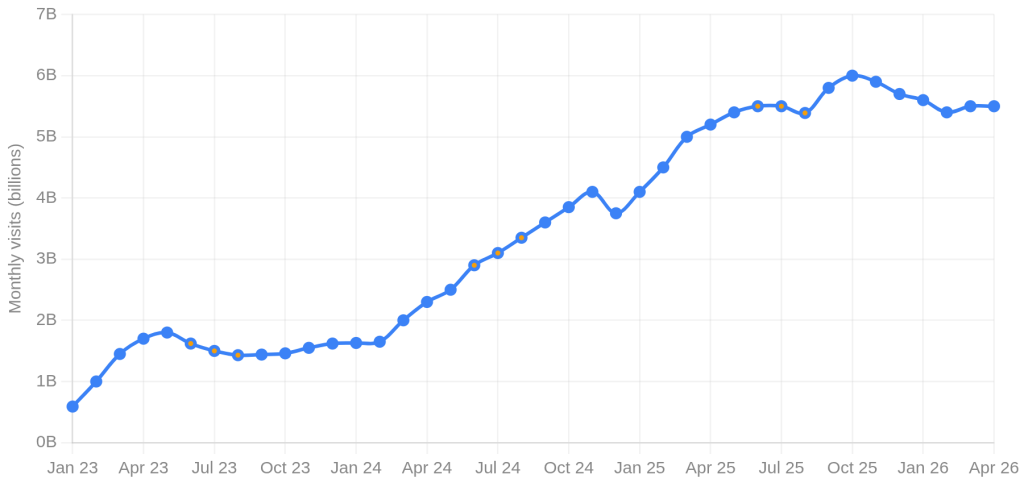
Note. Adapted from Similarweb, Semrush, SimilarWeb via FatJoe, and Elfsight (2023–2026).
Although generative AI can improve accessibility and save time, excessive reliance on these systems may gradually change student learning behavior. In some cases, students may prioritize obtaining fast answers rather than developing deep conceptual understanding or independent reasoning skills (Li et al., 2023). This issue may be particularly noticeable in fields such as computer science, where AI tools are now capable of generating complete code solutions, debugging errors, and explaining algorithms. While such systems can support learning and experimentation, students who depend heavily on generated solutions may struggle to develop algorithmic thinking and long-term problem-solving abilities.
The increasing use of generative AI also creates challenges for educational institutions attempting to evaluate genuine student understanding. Traditional homework assignments and take-home essays may no longer accurately reflect independent student work when AI-generated content can be produced quickly and with minimal effort. As a result, some universities and instructors have started placing greater emphasis on oral examinations, project-based assessments, and in-class activities designed to evaluate practical understanding rather than memorization or text generation alone (OECD, 2023). This shift suggests that the growth of AI in education may require not only technological adaptation but also significant changes in teaching and assessment methods.
AI and Educational Inequality in Tajikistan
Despite the growing global use of artificial intelligence in education, access to AI-based learning tools remains unequal across different countries and social groups. In developing countries such as Tajikistan, the implementation of AI in education is often limited by internet accessibility, digital infrastructure, language barriers, and unequal access to modern devices. According to UNESCO (2023), unequal access to digital technologies continues to affect educational opportunities in many developing regions, particularly in rural communities where stable internet connections and technological resources may be limited.
These challenges may significantly influence how effectively students can benefit from AI-based educational systems. In many cases, students in urban areas have greater access to high-speed internet, personal computers, and digital learning platforms than students living in rural regions. In addition, many advanced AI systems primarily operate in English, which may create additional difficulties for students who study mainly in Tajik or Russian. As a result, unequal technological access may widen existing educational gaps rather than reduce them.
The integration of artificial intelligence into education also requires teachers and institutions to develop sufficient digital literacy and technical understanding. However, educational institutions in developing countries may face financial limitations, insufficient teacher training, and lack of technological infrastructure necessary for large-scale AI implementation (OECD, 2023). Consequently, the successful use of AI in education depends not only on the availability of technology itself but also on broader institutional support, educational policy, and long-term investment in digital infrastructure.
For this reason, the future role of AI in countries such as Tajikistan will likely depend on how effectively educational institutions balance technological innovation with accessibility and educational equality. Without proper infrastructure, training, and support systems, the benefits of AI-based learning may remain concentrated among students with greater economic and technological advantages.
Academic Integrity and Changing Assessment Methods
The rapid development of generative AI has created significant challenges for maintaining academic integrity in modern education. Unlike traditional plagiarism, where students copy existing material from books or websites, AI-generated content can produce original-looking essays, reports, and programming solutions within seconds. As a result, detecting whether academic work was independently created by students has become increasingly difficult for teachers and educational institutions (UNESCO, 2023).
One major concern is that traditional assessment methods may no longer accurately measure genuine student understanding. Homework assignments completed outside the classroom can now be heavily assisted by AI systems capable of generating explanations, solving mathematical problems, or writing programming code with minimal user input. In some situations, students may submit technically correct work without fully understanding the underlying concepts. This issue may be especially important in computer science education, where students can use AI tools to generate complete algorithms or debug complex code automatically.
In response to these challenges, many educational institutions have started reconsidering how student performance should be evaluated. Some universities increasingly emphasize oral examinations, practical demonstrations, project-based learning, and in-class activities that require active participation and direct problem-solving (OECD, 2023). These approaches make it more difficult to rely entirely on AI-generated responses while encouraging students to demonstrate practical understanding and communication skills.
At the same time, completely banning artificial intelligence in education may not be realistic or effective. AI technologies are becoming increasingly integrated into professional and academic environments, meaning that students will likely continue using these tools in future workplaces. For this reason, many researchers argue that educational institutions should focus not only on restriction but also on responsible AI literacy, teaching students how to use AI systems ethically while maintaining independent reasoning and academic honesty (UNESCO, 2023).
Conclusion
Artificial intelligence is becoming an increasingly important part of modern education, influencing how students learn, how teachers manage educational tasks, and how institutions evaluate academic performance. AI-based systems can improve educational efficiency, provide personalized learning opportunities, and support students with faster access to information and learning materials. At the same time, the rapid expansion of generative AI has introduced important academic and ethical challenges related to dependency, critical thinking, academic integrity, and unequal access to technology.
The impact of artificial intelligence on education depends not only on the capabilities of the technology itself but also on how responsibly educational institutions integrate these systems into the learning process. While AI tools can support productivity and accessibility, excessive reliance on automated systems may weaken independent reasoning and reduce meaningful student engagement. In addition, unequal technological access in developing countries such as Tajikistan demonstrates that the benefits of AI in education are not distributed equally among all students and institutions.
For this reason, the future development of AI in education will likely require balanced integration rather than complete acceptance or rejection of these technologies. Educational institutions may need to redesign assessment methods, strengthen digital literacy, and encourage responsible AI usage while continuing to prioritize human interaction, critical thinking, and active learning. When implemented carefully and ethically, artificial intelligence can become a valuable supplementary tool that supports education without replacing the essential role of teachers and independent student thinking.
References
Guettala, M., Bourekkache, S., Kazar, O., & Harous, S. (2024). Generative artificial intelligence in education: Advancing adaptive and personalized learning. Acta Informatica Pragensia, 13(3), 460–489. https://doi.org/10.18267/j.aip.235
Li, M., Enkhtur, A., Cheng, F., & Yamamoto, B. A. (2023). Ethical implications of ChatGPT in higher education: A scoping review. arXiv. https://arxiv.org/abs/2311.14378
OECD. (2023). OECD Digital Education Outlook 2023: Towards an Effective Digital Education Ecosystem. OECD Publishing. https://doi.org/10.1787/c74f03de-en
Similarweb & Semrush. (2026). Monthly ChatGPT web traffic trends (2023–2026). Web analytics data compiled for educational analysis.
UNESCO. (2023). Guidance for generative AI in education and research. United Nations Educational, Scientific and Cultural Organization. https://www.unesco.org/en/articles/guidance-generative-ai-education-and-research