


Asoev Aminjon
Introduction
Young adults today face increasing academic, professional, and social pressures. University students are often expected to maintain high academic performance, develop technical skills, work part-time, and plan long-term careers simultaneously. This situation frequently creates stress and uncertainty. Some students consider leaving university, reducing responsibilities, or avoiding difficult subjects in order to reduce pressure. However, developmental psychology suggests that this period of life — known as emerging adulthood — is naturally characterized by instability, identity exploration, and multiple responsibilities (Arnett, 2000).
Rather than representing failure, these challenges may contribute to cognitive growth, resilience, and long-term professional stability. This paper argues that although emerging adulthood is marked by stress and uncertainty, sustained engagement in academic and professional responsibilities strengthens cognitive flexibility, self-control, and identity development, which are essential for later success. This argument is developed through three complementary frameworks: emerging adulthood theory (Arnett, 2000), grit theory (Duckworth et al., 2007), and research on cognitive engagement (Festini et al., 2016).
Emerging Adulthood as a Developmental Stage
Jeffrey Arnett (2000) introduced the concept of emerging adulthood to describe the period between ages 18 and 25. He argues that this stage is characterized by identity exploration, instability, self-focus, and feeling “in-between” adolescence and adulthood. Unlike adolescence, this period involves increased independence and responsibility. Unlike full adulthood, it lacks long-term stability.
Research shows that identity development during this period involves both exploration and commitment (Kroger et al., 2010). Young adults experiment with academic paths, professional interests, and personal values. Therefore, instability during this stage should not be interpreted as failure, but as part of normal psychological development.
Busyness and Cognitive Development
While many students experience busyness as stressful, research suggests that structured engagement may support cognitive functioning. Festini, McDonough, and Park (2016) found that higher levels of everyday busyness are positively associated with memory, reasoning ability, and processing speed. Their findings suggest that moderate levels of sustained activity may stimulate cognitive systems rather than damage them.
Additionally, Salmela-Aro and Tuominen-Soini (2010) demonstrate that goal orientation and sustained effort during educational transitions predict better long-term adjustment outcomes. These findings indicate that busyness, when connected to meaningful goals, can support psychological growth.
However, it is important to distinguish productive engagement from burnout. Excessive academic demands without adequate recovery may lead to emotional exhaustion and reduced engagement (Schaufeli et al., 2002). Therefore, busyness must be structured and purposeful rather than chaotic.
Grit Theory and Long-Term Perseverance
Another important framework is the concept of grit. Duckworth et al. (2007) define grit as perseverance and passion for long-term goals. Their research shows that individuals who maintain consistent effort despite difficulty are more likely to achieve academic and professional success.
Grit theory emphasizes discipline and sustained commitment. This perspective supports the idea that remaining engaged in studies and responsibilities during difficult periods may build long-term resilience. However, grit alone does not explain identity exploration or instability during ages 18–25. In addition, some researchers argue that grit may overlook structural and socioeconomic factors that influence individual success (Credé, 2018).
Critical Comparison: Grit vs Emerging Adulthood Theory
Emerging adulthood theory (Arnett, 2000) emphasizes exploration and instability as natural and necessary. In contrast, grit theory (Duckworth et al., 2007) emphasizes consistency and long-term perseverance.
A purely grit-focused approach may overlook the importance of experimentation and identity formation. On the other hand, excessive exploration without commitment may delay professional development. Therefore, an integrated perspective is more appropriate: emerging adulthood requires both structured exploration and disciplined effort.
This balanced view suggests that hardship and busyness during ages 18–25 contribute to development when they allow both persistence and identity growth.
Counterargument and Theoretical Tension
While grit theory (Duckworth et al., 2007) emphasizes perseverance and sustained effort, excessive emphasis on persistence may overlook individual well-being. Continuous exposure to demands without adequate recovery may lead to emotional exhaustion or reduced motivation. Similarly, although emerging adulthood theory (Arnett, 2000) recognizes instability as developmentally normal, prolonged instability without structured goal orientation may delay professional consolidation. Therefore, neither persistence nor exploration alone guarantees positive outcomes. Adaptive development likely requires a balance between structured engagement and psychological recovery.
Local Context: Tajikistan
In Tajikistan, emerging adulthood may involve additional economic pressures. Limited employment opportunities, family financial expectations, and competitive academic environments may increase stress for university students (World Bank, 2022; UNDP, 2020). In some cases, young adults must contribute financially to their families while continuing their education. These contextual factors may intensify the experience of busyness but may also accelerate responsibility development. Understanding emerging adulthood within this regional context highlights the importance of resilience, structured goal-setting, and long-term planning for young adults in Tajikistan.
Conceptual Developmental Model
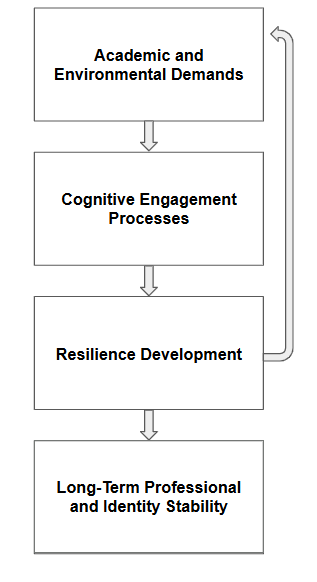
Drawing on emerging adulthood theory (Arnett, 2000), research on cognitive engagement (Festini et al., 2016), and grit theory (Duckworth et al., 2007), the present study proposes an integrated developmental model (see Figure 1). The model conceptualizes emerging adulthood as a dynamic process in which academic and environmental demands stimulate cognitive engagement processes. Sustained engagement contributes to resilience development, which in turn supports long-term professional and identity stability. Importantly, resilience also enhances the individual’s capacity to manage future demands, creating a reinforcing developmental feedback loop.
Figure 1
Benefits and Challenges of Busyness
Research on emerging adulthood indicates that sustained engagement in academic and environmental demands may support cognitive development and goal-directed behavior (Festini et al., 2016; Salmela-Aro & Tuominen-Soini, 2010). At the same time, this developmental period is characterized by instability, role transitions, and psychological stress (Arnett, 2000). Therefore, busyness during ages 18–25 may produce both adaptive and challenging outcomes. Table 1 summarizes the primary benefits and challenges associated with structured engagement during emerging adulthood.
Table 1
Benefits and Challenges of Busyness During Emerging Adulthood
| Benefits | Challenges |
| Enhanced cognitive functioning | Emotional stress |
| Strengthened self-regulation | Potential for burnout |
| Identity development | Developmental instability |
| Long-term resilience | Elevated academic demands |
Limitations and Contextual Considerations
Although research supports the developmental value of structured busyness (Festini et al., 2016), outcomes may vary depending on socioeconomic conditions and available institutional support (Arnett, 2000). In contexts where financial pressures are high, such as Tajikistan, early responsibility may reduce opportunities for extended identity exploration. Furthermore, the positive association between everyday busyness and cognitive functioning identified by Festini et al. (2016) does not necessarily imply that unlimited or unstructured overload would produce similar benefits. Future research should further examine the threshold at which structured engagement becomes counterproductive.
Conclusion
Emerging adulthood should therefore be understood not as a period defined by immediate achievement, but as a developmental stage characterized by growth under structured challenge. While busyness and responsibility during ages 18–25 may generate stress, research indicates that sustained cognitive engagement and resilience development contribute to long-term professional and identity consolidation (Arnett, 2000; Duckworth et al., 2007; Festini et al., 2016). However, optimal development depends on balance, as excessive demands without recovery may undermine well-being. Thus, emerging adulthood represents not a test of immediate success, but a foundational process of structured growth.
References:
Arnett, J. J. (2000). Emerging adulthood: A theory of development from the late teens through the twenties. American Psychologist, 55(5), 469–480. https://doi.org/10.1037/0003-066X.55.5.469
Credé, M. (2018). What shall we do about grit? A critical review of what we know and what we don’t know. Educational Researcher, 47(9), 606–611. https://doi.org/10.3102/0013189X18801322
Duckworth, A. L., Peterson, C., Matthews, M. D., & Kelly, D. R. (2007). Grit: Perseverance and passion for long-term goals. Journal of Personality and Social Psychology, 92(6), 1087–1101. https://doi.org/10.1037/0022-3514.92.6.1087
Festini, S. B., McDonough, I. M., & Park, D. C. (2016). The busier the better: Greater busyness is associated with better cognition. Frontiers in Aging Neuroscience, 8, 98. https://doi.org/10.3389/fnagi.2016.00098
Kroger, J., Martinussen, M., & Marcia, J. E. (2010). Identity status change during adolescence and young adulthood: A meta-analysis. Journal of Adolescence, 33(5), 683–698. https://doi.org/10.1016/j.adolescence.2009.11.002
Salmela-Aro, K., & Tuominen-Soini, H. (2010). Young people’s motivation and goal orientation during the transition to adulthood. Journal of Youth and Adolescence, 39(8), 875–889. https://doi.org/10.1007/s10964-009-9438-2
Schaufeli, W. B., Martínez, I. M., Pinto, A. M., Salanova, M., & Bakker, A. B. (2002). Burnout and engagement in university students. Journal of Cross-Cultural Psychology, 33(5), 464–481. https://doi.org/10.1177/0022022102033005003
United Nations Development Programme. (2020). Human development report 2020: Tajikistan. https://www.undp.org
World Bank. (2022). Tajikistan economic update. https://www.worldbank.org
